

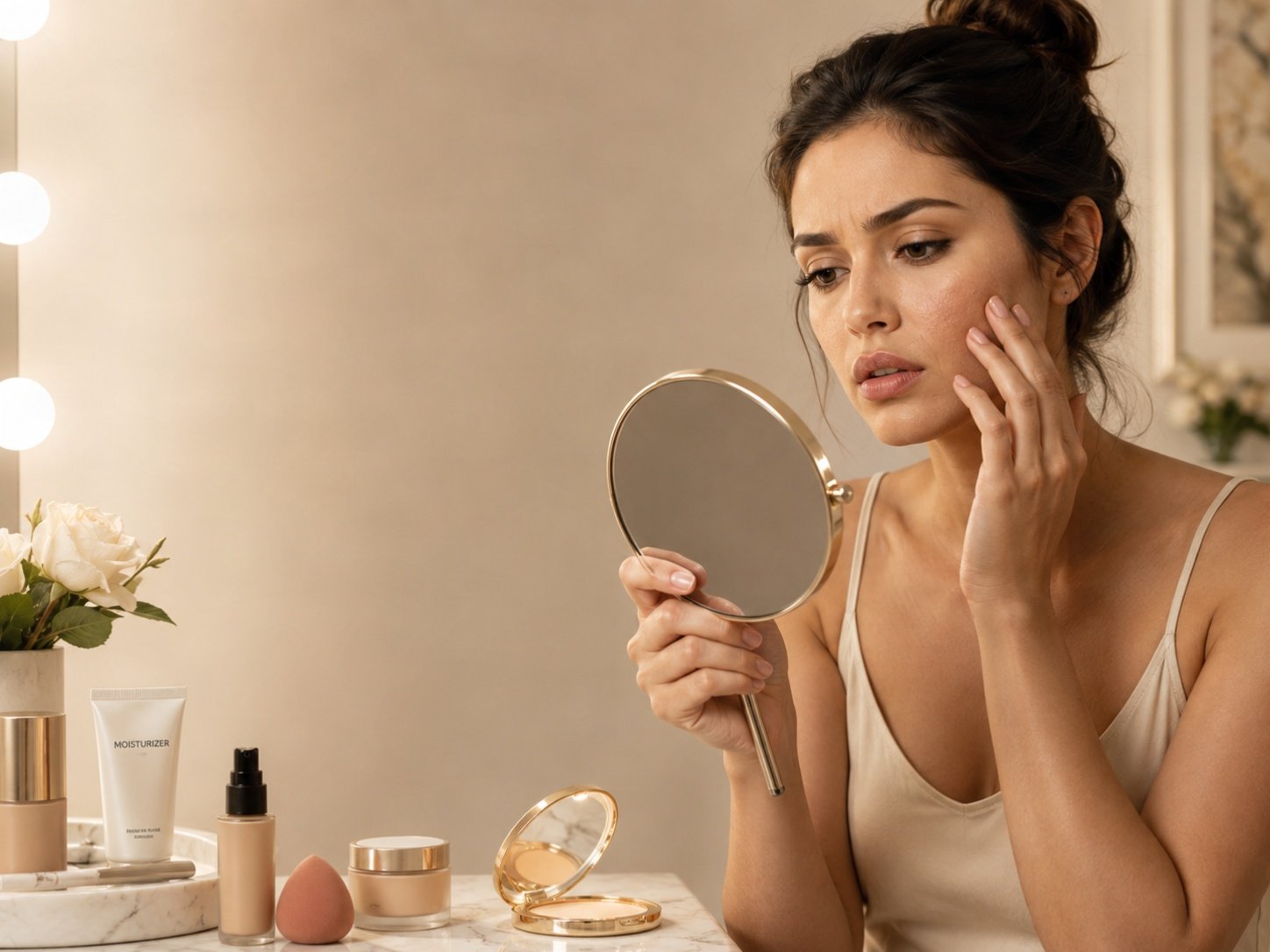
Cakey foundation has a way of showing up at the worst time. You blend, tap, set, and step back, thinking your base looks fine. Then the sunlight hits, and suddenly your foundation is sitting in dry patches, gathering around pores, clinging to texture, or looking thick around your nose and smile lines.
If you are trying to understand why your foundation looks cakey, the answer is usually not one single mistake. It is often a mix of skin prep, product texture, application, powder, shade match, and how your skin behaves throughout the day.
I look at cakey foundation as a layering problem. Your skin, skincare, primer, sunscreen, foundation, concealer, and powder all have to work together. When one layer is too dry, too oily, too heavy, or applied too quickly, the whole base can start to look uneven.
The American Academy of Dermatology dry skin guidance explains that dry skin can benefit from using moisturizer and choosing products that help relieve dryness. That matters because foundation often looks cakier when it is applied over dry, flaky, or tight skin.
Let’s break down why your foundation looks cakey, how to fix it, and how to build a smoother base without piling on more product.
Why Cakey Foundation Usually Starts Before Foundation
When someone asks me why your foundation looks cakey, I usually ask about the skin prep first.
Foundation does not sit on a blank canvas. It sits on skin that may be dry, oily, textured, dehydrated, irritated, over-exfoliated, or layered with skincare that has not fully absorbed. A foundation that looks heavy on one day may look beautiful on another day simply because your skin was better prepped.
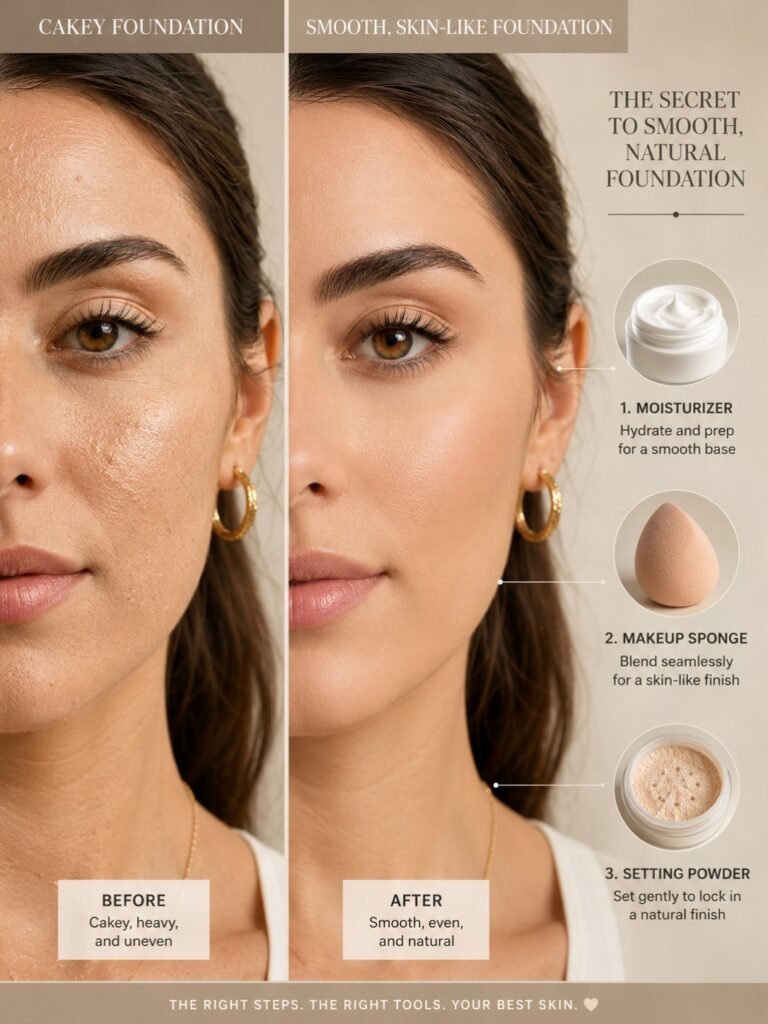
Cakey foundation often happens when:
- Skin is dry or flaky
- Moisturizer is skipped or too heavy
- Sunscreen has not settled
- Primer and foundation do not layer well
- Too much foundation is applied at once
- Too much powder is used
- Foundation is the wrong finish for your skin type
- Makeup is touched up with more product instead of blotting first
If your skin is acne-prone, product choice also matters. The American Academy of Dermatology acne habits guide recommends using makeup, sunscreen, skincare, and hair-care products labeled “non-comedogenic” or “won’t clog pores.” That can be helpful when you want a smoother base without adding products that may contribute to breakouts.
This article is for general beauty and skincare education only. If your skin is painful, inflamed, severely peeling, burning, or breaking out suddenly, I recommend speaking with a dermatologist or qualified healthcare professional.
10 Reasons Why Your Foundation Looks Cakey
1. Your Skin Is Too Dry or Flaky
One of the biggest reasons why your foundation looks cakey is dry skin.
Foundation can cling to flakes, rough patches, and uneven texture. Instead of looking smooth, it gathers on top of dry areas and makes them more obvious. This often happens around the nose, between the brows, on the chin, around the mouth, and on the cheeks.
Dry skin may feel:
- Tight
- Rough
- Flaky
- Dull
- Itchy
- Sensitive
- Stinging when products are applied
The American Academy of Dermatology dry skin tips recommend applying moisturizer when your skin feels dry and using products that contain ingredients such as petrolatum, mineral oil, shea butter, glycerin, dimethicone, hyaluronic acid, or jojoba oil.
What to try:
- Moisturize before makeup
- Give moisturizer time to absorb
- Use a creamier moisturizer if your skin is flaky
- Avoid harsh scrubs on dry skin
- Use less foundation over dry patches
- Press foundation in instead of dragging it
If foundation always looks cakey in the same dry areas, the fix may be better skin prep, not more foundation.
2. You Are Applying Too Much Foundation
More foundation does not always mean more coverage. Sometimes it just means more texture.
If you apply a thick layer all over your face, the product has nowhere to go. It can settle into pores, lines, dry patches, and folds. This is a common reason why your foundation looks cakey, especially with full-coverage formulas.
I recommend starting with less than you think you need. Apply a thin layer first, then build only where you want more coverage.
What to try:
- Start with one small pump or less
- Apply foundation in the center of the face first
- Blend outward toward the hairline
- Add coverage only where needed
- Use concealer for spots instead of more foundation everywhere
- Step back from the mirror before adding more
A thin, even layer usually looks more polished than a thick layer trying to hide everything.
3. Your Moisturizer Is Not Working With Your Foundation
Moisturizer can make foundation look better, but the wrong moisturizer can make it separate, slide, pill, or look heavy.
If your moisturizer is too rich, foundation may sit on top and move around. If it is too light, your skin may still look dry underneath. If it has not absorbed, your foundation may mix with it instead of sitting smoothly.
The Cleveland Clinic moisturizer guidance explains that moisturizers can include humectants, occlusives, and emollients, and that different formulas work better for different levels of dryness. This is why a moisturizer that works beautifully at night may be too heavy under makeup.
What to try:
- Use a lighter moisturizer in the morning if makeup slides
- Use a richer moisturizer if foundation clings to dry patches
- Wait a few minutes before applying foundation
- Blot excess skincare if your face feels slippery
- Match moisturizer texture to your foundation finish
If you want to know why your foundation looks cakey even after moisturizing, check whether your moisturizer is actually compatible with your base.
4. Your Primer and Foundation Do Not Layer Well
Primer can help makeup last, but it can also make foundation look cakey if the textures clash.
A silicone-heavy primer, gripping primer, rich moisturizer, dewy sunscreen, and matte foundation may not all play nicely together. If your base pills, rolls up, or separates, your products may not be compatible.
You do not always need primer. Sometimes well-prepped skin and the right foundation are enough.
What to try:
- Skip primer for one day and compare
- Use primer only where needed
- Let skincare and sunscreen settle first
- Avoid layering too many slippery products
- Pair matte primer with oily areas, not the whole face
- Use hydrating primer only where skin is dry
A common mistake is using primer everywhere because it feels like a required step. I prefer using it strategically.
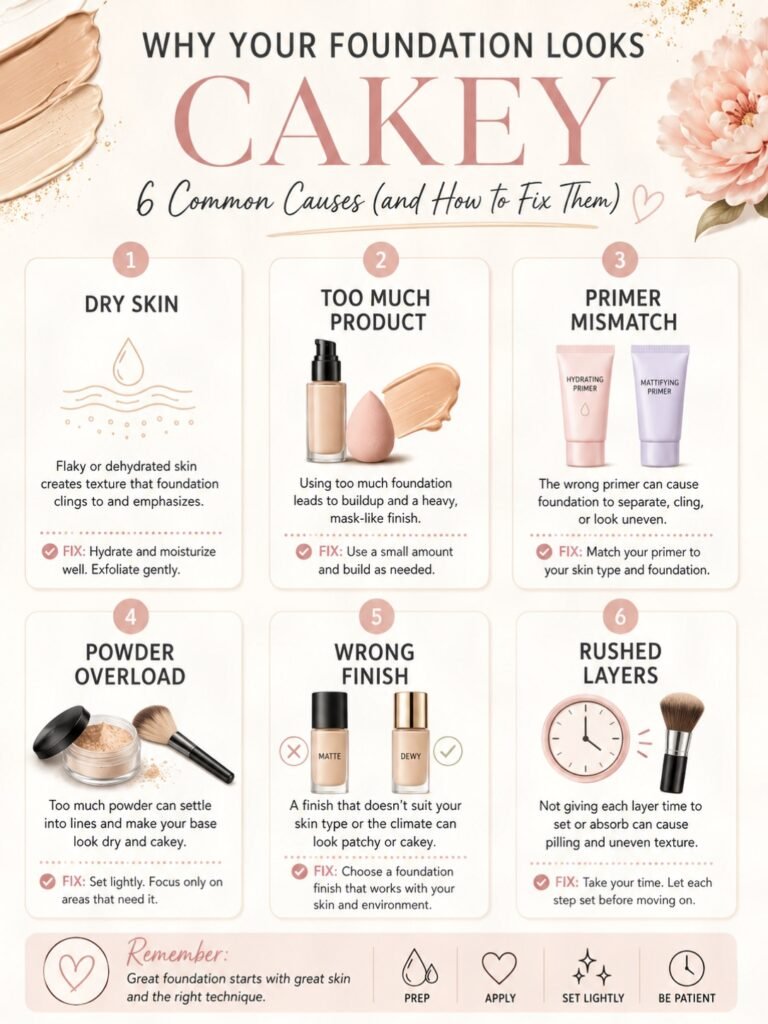
5. Your Foundation Finish Does Not Match Your Skin Type
Another reason why your foundation looks cakey is that the formula does not match your skin.
A very matte foundation can exaggerate dry patches. A very dewy foundation can separate on oily skin and look thick after powder. A heavy cream foundation may look beautiful in photos but feel too much for everyday wear.
For oily skin, the American Academy of Dermatology oily skin tips recommend using products labeled “oil free” and “noncomedogenic,” and using blotting papers to reduce shine. That advice can also help when choosing makeup that does not become heavy or patchy during the day.
What to try:
- Dry skin: try hydrating, satin, or natural-finish foundation
- Oily skin: try oil-free, soft matte, or long-wear foundation
- Combination skin: use different prep in different zones
- Textured skin: avoid overly thick layers
- Mature skin: use thinner layers and less powder
The best foundation is not always the fullest coverage. It is the one that looks most like skin after a few hours.
6. You Are Using Too Much Powder
Powder can set makeup, reduce shine, and keep foundation from moving. But too much powder can make foundation look dry, thick, and textured.
This is especially true under the eyes, around the mouth, and on dry cheeks. Powder can grab onto foundation and create a chalky or heavy finish.
If you are asking why your foundation looks cakey by midday, your setting technique may be the problem.
What to try:
- Use powder only where you need it
- Press powder instead of sweeping too much
- Set the T-zone first
- Use a smaller brush under the eyes
- Avoid baking dry areas
- Try blotting before adding more powder
I recommend powdering in thin layers. You can always add a little more, but removing too much powder without disturbing makeup is harder.
7. You Are Applying Makeup Too Quickly
Foundation can look cakey when layers do not have time to settle.
If you apply moisturizer, sunscreen, primer, foundation, concealer, cream blush, and powder within two minutes, the layers may mix, slip, or pill. Your base needs a little breathing room.
This matters especially if you wear sunscreen. The American Academy of Dermatology sunscreen FAQ recommends applying sunscreen to dry skin 15 minutes before going outdoors. While that advice is about sun protection, it also reminds me that sunscreen needs time to form an even layer before other products disturb it.
What to try:
- Let skincare absorb before makeup
- Let sunscreen settle before foundation
- Apply foundation in thin layers
- Wait briefly before powder
- Do another task between skincare and makeup
- Avoid rubbing products back and forth
Your routine does not have to be long, but it should not feel rushed and slippery.
8. You Are Blending With the Wrong Tool or Technique
The same foundation can look different depending on how you apply it.
A dense brush can give more coverage, but it can also create streaks or make dry skin look rough if you drag it. A damp sponge can soften the finish, but it may remove coverage if you bounce too aggressively. Fingers can work well for some formulas, but not all.
What to try:
- Use a damp sponge for a softer finish
- Use a brush for targeted coverage
- Press and tap instead of dragging
- Blend thin layers
- Use less product around textured areas
- Smooth edges around the nose, jaw, and hairline
If your foundation looks thick, I would try a damp sponge before changing the foundation itself.
9. Your Shade or Undertone Is Slightly Off
A foundation can look cakey even when the texture is not terrible if the shade is too light, too dark, too pink, too yellow, or too gray.
When the color does not blend with your skin, every edge and textured area becomes more noticeable. A too-light shade can look chalky. A too-warm shade can look heavy. A gray or ashy shade can make the skin look dull.
What to try:
- Match foundation to your jawline and neck
- Check it in natural light
- Wait a few minutes to see if it oxidizes
- Try mixing two shades if you are between colors
- Use less foundation around the jawline
- Choose undertone carefully
Sometimes what looks like cakey makeup is really a shade mismatch making the makeup more visible.
10. You Keep Touching Up With More Foundation
Touching up with more foundation can make cakiness worse.
By midday, your skin may have oil, sweat, powder, sunscreen, and old foundation sitting on it. If you add more foundation directly on top, the base may become thick, patchy, or textured.
A better touch-up starts with removing excess oil or moisture first.
What to try:
- Blot oil before adding powder
- Smooth creasing with a clean fingertip
- Add concealer only where coverage faded
- Use setting spray lightly if makeup looks powdery
- Avoid layering liquid foundation over heavy powder
- Touch up small areas, not the whole face
This is a major reason why your foundation looks cakey later in the day even if it looked smooth in the morning.
How to Fix Cakey Foundation Without Starting Over
If your makeup already looks cakey, you do not always need to wash your face and start again.
Try this quick rescue routine:
- Stop adding more foundation.
- Look closely at what is wrong: dryness, oil, powder, or separation.
- If it is too powdery, mist lightly with setting spray or facial mist.
- Press with a damp sponge to soften texture.
- If it is oily, blot first, then powder lightly.
- If it has settled into lines, tap the area with a clean fingertip.
- If dry flakes are showing, press on a tiny amount of moisturizer around the edges.
- Do not scrub or rub the area aggressively.
The key is to adjust the texture without adding too many new layers.
My Smooth Foundation Routine
When I want foundation to look more skin-like, I keep the routine simple.
Step 1: Prep the Skin
Cleanse gently, moisturize based on your skin type, and let skincare settle.
Step 2: Apply Sunscreen
Use sunscreen during the day and give it time to sit before makeup.
Step 3: Prime Only Where Needed
Use primer on oily areas, pores, or dry patches only if it actually improves the base.
Step 4: Apply Thin Foundation
Start with a small amount and blend from the center of the face outward.
Step 5: Conceal Strategically
Use concealer for dark spots, blemishes, redness, or under-eye darkness instead of adding foundation everywhere.
Step 6: Set Lightly
Powder only the areas that crease, move, or get shiny.
Step 7: Check in Natural Light
Natural light will tell you the truth before you leave the house.
This routine helps prevent the most common reasons why your foundation looks cakey without making the process complicated.
Best Product Types for a Smoother Base
The right product depends on your skin, but these categories can help.
For Dry Skin
Look for:
- Hydrating primer
- Cream moisturizer
- Satin foundation
- Skin tint
- Lightweight concealer
- Minimal powder
- Setting spray used lightly
For Oily Skin
Look for:
- Oil-free moisturizer
- Lightweight gel moisturizer
- Soft matte foundation
- Non-comedogenic makeup
- Blotting papers
- Powder only where needed
For Combination Skin
Look for:
- Lightweight moisturizer all over
- Extra moisture on dry patches
- Primer only on oily zones
- Satin or natural-finish foundation
- Targeted powder
For Textured Skin
Look for:
- Thin foundation layers
- Smoothing primer only where needed
- Damp sponge application
- Less powder on raised texture
- Setting spray to soften the finish
The goal is not to hide all skin texture. Real skin has pores, lines, and movement. The goal is to avoid making texture look heavier than it is.
Common Mistakes That Make Foundation Look Cakey
Skipping Skin Prep
Foundation usually looks better when the skin is clean, comfortable, and moisturized.
Using Too Much Coverage Everywhere
Full coverage does not need to go all over the face. Use it where you need it.
Powdering the Whole Face Heavily
Powder only where makeup moves, creases, or gets oily.
Applying Foundation Over Flakes
Foundation will usually cling to flakes. Moisturize and smooth dry areas first.
Using the Wrong Finish
Matte foundation can look dry on dry skin. Dewy foundation can look greasy on oily skin.
Touching Up Without Blotting
Adding product over oil often creates thickness and separation.
Ignoring Sunscreen Texture
A greasy or pilling sunscreen can affect how foundation sits on top.
FAQ
Why does my foundation look cakey?
Foundation can look cakey when skin is dry, the foundation is applied too thickly, the moisturizer or primer does not layer well, too much powder is used, the formula does not match your skin type, or makeup is touched up with more product instead of blotting first.
Why your foundation looks cakey even with primer?
Primer does not fix every base issue. Your foundation may still look cakey if your skin is dry, your primer and foundation do not layer well, you use too much product, or you set with too much powder.
How do I stop foundation from looking cakey on dry skin?
Moisturize well, let skincare absorb, use a hydrating or satin foundation, apply thin layers, avoid heavy powder on dry areas, and press foundation into the skin instead of rubbing.
How do I stop foundation from looking cakey on oily skin?
Use lightweight skincare, choose oil-free or soft matte foundation, apply thin layers, set only oily areas, blot during the day, and avoid adding more foundation over oil.
Is powder making my foundation cakey?
It can. Too much powder can make foundation look dry, thick, and textured. Try using less powder and applying it only where your makeup creases or gets shiny.
Why does my foundation look cakey around my nose?
Foundation often cakes around the nose because of texture, dryness, oil, movement, and too much product. Use less foundation there, blend carefully, and set lightly only where needed.
Can setting spray fix cakey foundation?
Setting spray can soften a powdery finish, but it will not fully fix too much product, poor skin prep, or a foundation that does not suit your skin type.
Conclusion
Why your foundation looks cakey usually comes down to layers. Dry skin, heavy foundation, incompatible skincare, too much powder, the wrong finish, rushed application, or midday touch-ups can all make your base look thicker than you intended.
I recommend starting with the simplest changes: moisturize properly, use less foundation, apply thin layers, powder only where needed, and blot before touching up.
Once you understand why your foundation looks cakey, it becomes much easier to build a base that looks smooth, fresh, and more like real skin.
Sources
- American Academy of Dermatology dry skin tips: https://www.aad.org/public/everyday-care/skin-care-basics/dry/dermatologists-tips-relieve-dry-skin
- American Academy of Dermatology acne habits guide: https://www.aad.org/public/diseases/acne/skin-care/habits-stop
- American Academy of Dermatology oily skin tips: https://www.aad.org/public/everyday-care/skin-care-basics/dry/oily-skin
- American Academy of Dermatology sunscreen FAQ and SPF guidance: https://www.aad.org/media/stats-sunscreen
- Cleveland Clinic moisturizer guidance for dry skin: https://health.clevelandclinic.org/how-to-choose-the-best-moisturizer-for-your-dry-skin