

Chin breakouts can feel personal because they tend to show up where you notice them most: around the mouth, along the jaw, or right in the center of the face. One spot heals, another appears, and before long it feels like your chin has its own breakout schedule. If you are wondering why your chin keeps breaking out, the answer is usually a mix of hormones, clogged pores, product residue, touching, picking, stress, and habits that quietly irritate the skin.
I recommend looking for patterns before blaming one product or one meal. Chin acne often has clues: timing, location, pain level, and what changed in your routine. Once you know the likely trigger, it becomes much easier to calm the cycle.
Why Chin Breakouts Can Be So Stubborn
Chin breakouts are frustrating because they often repeat in the same zone. The chin and lower face can be affected by oil production, friction, skincare and makeup buildup, hormonal shifts, and touching habits.
The American Academy of Dermatology adult acne guide explains that adult acne can be linked to fluctuating hormones, stress, family history, and hair or skincare products. AAD also recommends checking product labels for terms like “non-comedogenic,” “oil-free,” “non-acnegenic,” or “won’t clog pores.”
The Cleveland Clinic hormonal acne guide notes that hormonal acne can be influenced by changing hormone levels, stress, certain medications, family history, and some medical conditions. It can also become red, inflamed, painful, or sore.
This article is for general skincare education only. If your chin acne is painful, cystic, infected, spreading, leaving scars, or not improving with over-the-counter care, I recommend speaking with a dermatologist or qualified healthcare professional.
10 Reasons Why Your Chin Keeps Breaking Out
1. Hormonal Changes May Be Triggering Lower-Face Acne
One of the most common reasons why your chin keeps breaking out is hormonal fluctuation.
This is especially common when chin acne appears as deeper, sore bumps along the chin, jawline, or lower face. It may flare before your period, during stressful seasons, after starting or stopping certain birth control methods, during pregnancy, during perimenopause, or with hormonal conditions.
The AAD adult acne guide explains that women often experience fluctuating hormones around their periods, during pregnancy, during perimenopause and menopause, and after starting or stopping birth control pills. The AAD hormonal therapy acne guide also says women with acne along the jawline and lower face may respond well to hormonal therapy when appropriate.
What to look for:
- Breakouts that appear before your period
- Deep, tender bumps on the chin or jawline
- Acne that keeps returning in the same lower-face area
- Breakouts that do not respond well to basic spot treatments
- Chin acne that appears with irregular periods or other hormonal symptoms
I would not self-diagnose hormonal acne, but I would track the timing. Patterns can help your dermatologist choose the right treatment plan.
2. Your Products May Be Clogging Your Pores
If your chin breaks out repeatedly, check everything that touches that area: moisturizer, sunscreen, primer, foundation, concealer, lip balm, shaving products, and even hair products.
The AAD acne habits guide explains that makeup, sunscreen, skincare, and hair-care products can contain oil or other ingredients that contribute to acne. AAD recommends using products labeled “non-comedogenic” or “won’t clog pores.”
What to try:
- Choose non-comedogenic moisturizer and sunscreen
- Check whether your foundation or concealer is heavy around the chin
- Avoid applying thick lip balm beyond the lip line
- Keep hair products away from the lower face
- Remove makeup every night
- Wash makeup brushes and sponges regularly
If you are trying to understand why your chin keeps breaking out, product residue is one of the first things I would investigate.
3. You May Be Touching Your Chin More Than You Realize
The chin is an easy place to touch without noticing. Resting your chin in your hand, rubbing your face while thinking, leaning on your desk, adjusting a mask, or touching spots in the mirror can all irritate acne-prone skin.
The AAD acne management tips recommend keeping your hands off your face because touching can cause acne to flare. AAD also warns that picking, popping, or squeezing acne can make it take longer to clear and increase the risk of scarring and dark spots.
What to try:
- Notice when your hand goes to your chin
- Keep nails short if you pick absentmindedly
- Use a pimple patch as a barrier
- Clean your phone screen regularly
- Avoid leaning your chin on your hand
- Step away from magnifying mirrors
This is a small habit, but it can make a big difference when breakouts keep coming back in the same place.
4. You Are Over-Washing or Scrubbing the Area
When your chin breaks out, it is tempting to scrub harder. I understand the instinct, but scrubbing can irritate the skin and make acne look angrier.
The Mayo Clinic acne treatment guide recommends washing problem areas with a gentle cleanser and warm water, using your hands, and avoiding facial scrubs, astringents, and masks that can irritate the skin. Mayo Clinic also notes that too much washing and scrubbing can irritate skin.
The AAD acne habits guide says washing your face several times a day can further irritate the skin and lead to more breakouts.
What to try:
- Wash your face twice daily and after sweating
- Use your fingertips instead of a scrub brush
- Avoid harsh exfoliating cleansers on active breakouts
- Pat skin dry instead of rubbing
- Use acne treatments as directed
- Moisturize if your skin feels dry
If your chin feels tight, flaky, or raw, the issue may be irritation layered on top of acne.
5. You Are Drying Out Your Skin With Too Many Acne Treatments
Another reason why your chin keeps breaking out is that your routine may be too harsh.
It is easy to apply benzoyl peroxide, salicylic acid, retinoids, exfoliating toner, clay masks, and drying spot treatments all in the same week. That may feel proactive, but irritated skin can become more inflamed, flaky, and reactive.
The AAD acne habits guide explains that dry skin is irritated skin, and irritated skin can raise the risk of more acne. AAD recommends using acne treatments as directed and applying moisturizer made for acne-prone skin if skin feels dry.
What to try:
- Use one main acne treatment at a time
- Avoid layering multiple drying products
- Add a lightweight non-comedogenic moisturizer
- Reduce exfoliation if your skin stings or flakes
- Give treatments time to work before switching
- Avoid rubbing alcohol or harsh astringents
A calmer routine often works better than a punishing one.
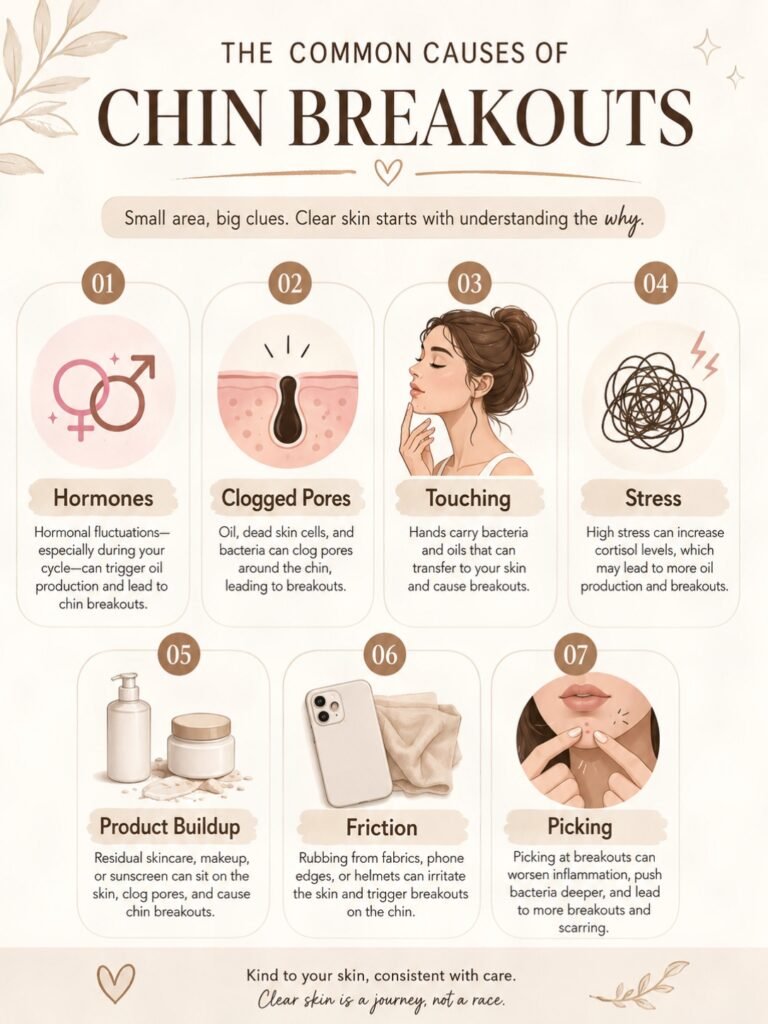
6. Stress May Be Making Chin Acne Flare
Stress does not mean your acne is “in your head.” Stress can affect the skin.
The AAD adult acne guide explains that researchers have found a relationship between stress and acne flare-ups. In response to stress, the body produces more androgens, which can stimulate oil glands and hair follicles.
The Cleveland Clinic hormonal acne guide also lists stress as something that can make hormonal acne worse.
What to try:
- Track breakouts during stressful weeks
- Keep your routine simple when life is busy
- Avoid picking during stress moments
- Prioritize sleep when possible
- Use pimple patches if stress picking is a habit
- Do not start five new products at once during a flare
Stress care is not a replacement for acne treatment, but it can support the bigger picture.
7. Picking or Squeezing Is Extending the Breakout Cycle
Picking can turn a small chin breakout into a longer healing process.
The AAD acne habits guide warns that popping or squeezing acne can push pus, dead skin cells, or bacteria deeper into the skin, increasing inflammation and sometimes causing scarring and pain.
What to try:
- Use a hydrocolloid patch over tempting spots
- Step away from the mirror after applying skincare
- Keep extraction tools out of reach
- Use a cold compress for swelling
- Avoid squeezing deep painful bumps
- See a dermatologist for stubborn or painful acne
This is one of the most practical answers to why your chin keeps breaking out. Sometimes the original acne is only half the problem. The repeated touching keeps the cycle going.
8. Your Chin Area May Be Getting Friction or Occlusion
Friction and trapped sweat can make acne worse for some people. Around the chin, this can happen from masks, helmet straps, chin straps, scarves, sports gear, or resting your chin against your hand.
Even if the trigger is not the same for everyone, I look at repeated contact whenever acne keeps appearing in a specific area.
What to try:
- Change masks regularly if you wear them
- Wash reusable fabric items that touch your chin
- Keep helmet straps clean
- Avoid tight chin straps when possible
- Cleanse after sweating
- Use a gentle moisturizer to reduce rubbing irritation
If your chin acne appears exactly where something rubs, friction may be part of the pattern.
9. Shaving, Waxing, or Hair Removal May Be Irritating the Area
Chin bumps are not always classic acne. Shaving, waxing, threading, plucking, or dermaplaning can irritate follicles and create bumps that look like acne.
This may be more likely if the bumps appear soon after hair removal, feel tender, or cluster around the areas where hair grows.
What to try:
- Use a clean razor if shaving
- Shave gently in the direction that works best for your skin
- Avoid shaving over active inflamed pimples
- Skip waxing or threading during an irritated breakout
- Moisturize after hair removal
- See a professional if ingrown hairs are frequent
If your “chin acne” always follows hair removal, the fix may be changing the hair-removal method, not adding stronger acne products.
10. Your Acne Treatment Has Not Had Enough Time to Work
Chin acne can feel urgent, but acne treatment usually takes time.
The AAD acne habits guide says you should give an acne treatment 6 to 8 weeks to see some improvement, and that complete clearing generally takes 3 to 4 months. The Mayo Clinic acne treatment guide also notes that it may take a few weeks of using an acne product before seeing improvement.
What to try:
- Pick one acne treatment plan and stay consistent
- Do not switch products every few days
- Take progress photos weekly, not daily
- Treat acne-prone areas, not only visible pimples
- Moisturize to reduce irritation
- See a dermatologist if over-the-counter care is not helping
If you keep changing routines, you may never know what actually works.
How to Calm Chin Breakouts Without Making Them Worse
If your chin is already breaking out, I would keep the routine calm and consistent.
Morning Routine
- Cleanse gently or rinse if your skin is dry
- Apply a lightweight non-comedogenic moisturizer
- Use a non-comedogenic sunscreen
- Apply light makeup only if desired
- Avoid touching or picking during the day
Night Routine
- Remove makeup and sunscreen
- Cleanse gently
- Apply one acne treatment as directed
- Moisturize
- Use a pimple patch on spots you keep touching
The AAD acne management tips recommend gentle cleansing up to twice daily and after sweating, gentle alcohol-free skincare, sticking with treatment long enough to work, keeping hands off the face, and using non-comedogenic sunscreen.
Best Over-the-Counter Ingredients for Chin Acne
When choosing acne products, I recommend starting with proven ingredients and using them consistently.
The Mayo Clinic nonprescription acne treatment guide explains that benzoyl peroxide can help kill acne-causing bacteria, remove excess oil, and remove dead skin cells that clog pores. The Mayo Clinic acne treatment guide also lists benzoyl peroxide, adapalene, salicylic acid, glycolic acid, and alpha hydroxy acids as over-the-counter acne options.
Benzoyl Peroxide
Best for inflamed pimples and acne-prone areas, but it can be drying. Start carefully and moisturize.
Salicylic Acid
Best for clogged pores, blackheads, and oily areas. Avoid overusing it if your skin gets dry or irritated.
Adapalene
Best for recurring clogged pores and acne prevention. It can take weeks to show improvement and may cause dryness at first.
Azelaic Acid
Often used for acne-prone skin and post-breakout discoloration, though many people need guidance on strength and frequency.
Non-Comedogenic Moisturizer
Not an acne treatment, but important. Dry irritated skin can make acne harder to tolerate and easier to pick.
What to Avoid When Your Chin Keeps Breaking Out
Do Not Scrub the Breakout
Scrubbing can irritate the skin and make acne look worse.
Do Not Pop Deep Pimples
Deep chin bumps are more likely to become inflamed, painful, or scarred when squeezed.
Do Not Keep Switching Products
Give acne treatment time to work before changing the entire routine.
Do Not Skip Moisturizer
A light, non-comedogenic moisturizer can help reduce dryness from acne treatments.
Do Not Sleep in Makeup
The AAD acne habits guide recommends removing makeup before bed because even non-comedogenic makeup can contribute to acne if you sleep in it.
Do Not Assume All Chin Bumps Are Acne
Ingrown hairs, irritation, dermatitis, folliculitis, and perioral dermatitis can sometimes look like acne. If your bumps burn, itch, spread, or do not respond to acne treatment, get professional guidance.
When Chin Acne May Be Hormonal
Chin and jawline acne is often discussed as hormonal acne, but not every chin breakout is hormonal. I would consider a hormonal pattern more likely when breakouts are deep, sore, recurring, and timed around hormonal changes.
The AAD hormonal therapy acne guide says women with acne along the lower face, jawline, and neck may want to consider hormonal therapy, especially when acne continues despite trying other treatments. AAD notes that oral contraceptive pills and spironolactone are two hormonal therapies that can effectively clear acne in women when prescribed appropriately.
The Cleveland Clinic adult acne article also explains that a dermatologist can assess acne, identify the underlying cause, and may use hormonal therapy when acne appears hormone-driven.
I do not recommend starting hormonal treatment without medical guidance. It requires a personal health review.
When to See a Dermatologist
I recommend seeing a dermatologist or qualified healthcare professional if:
- Chin acne is deep, painful, or cystic
- Breakouts keep coming back in the same area
- Acne leaves scars or dark spots
- Over-the-counter products are not helping
- You suspect hormonal acne
- You have irregular periods or other hormonal symptoms
- Skin becomes swollen, hot, infected, or very painful
- Bumps may not be acne
- Acne affects your confidence or daily life
The AAD acne diagnosis and treatment page explains that board-certified dermatologists can create an effective treatment plan for acne. The Mayo Clinic acne treatment guide recommends seeing a doctor when acne does not respond to self-care and over-the-counter treatment.
FAQ
Why does my chin keep breaking out?
Your chin may keep breaking out because of hormonal changes, clogged pores, comedogenic skincare or makeup, touching your face, stress, picking, over-washing, harsh acne treatments, friction, hair removal irritation, or acne treatment that has not had enough time to work.
Is chin acne hormonal?
Chin acne can be hormonal, especially if it appears as deep, painful bumps around the chin, jawline, or lower face and flares around your menstrual cycle or other hormonal changes. A dermatologist can help confirm the likely cause.
How do I stop chin breakouts?
To reduce chin breakouts, use gentle skincare, choose non-comedogenic products, remove makeup before bed, avoid picking, use one acne treatment consistently, moisturize, clean anything that touches your chin, and see a dermatologist if acne is persistent or painful.
What ingredients help chin acne?
Common over-the-counter acne ingredients include benzoyl peroxide, salicylic acid, and adapalene. Start slowly, avoid layering too many drying treatments, and moisturize to reduce irritation.
Why do I only break out on my chin and jawline?
Breakouts limited to the chin and jawline may be related to hormones, product residue, touching, friction, shaving or hair removal, or recurring clogged pores in that area.
Can lip balm cause chin acne?
Some lip balms or heavy lip products may spread beyond the lips and clog pores around the mouth or chin, especially if they are thick or oily. If breakouts cluster near the lip line or chin, try switching products.
Should I pop chin pimples?
No. Popping chin pimples can increase inflammation, pain, infection risk, scarring, and dark marks. Use a pimple patch, spot treatment, or warm compress for deep painful bumps instead.
Conclusion
If you keep asking why your chin keeps breaking out, start by looking for patterns. Chin acne may be linked to hormones, pore-clogging products, touching, stress, picking, harsh cleansing, friction, or hair removal irritation.
I recommend keeping your routine simple: gentle cleanser, non-comedogenic moisturizer, sunscreen, one acne treatment, and no picking. Then track your timing, products, and habits for a few weeks.
Once you understand why your chin keeps breaking out, you can stop chasing every new spot and start building a calmer, more consistent plan that gives your skin a real chance to clear.
Sources
- American Academy of Dermatology adult acne guide: https://www.aad.org/public/diseases/acne/really-acne/adult-acne
- American Academy of Dermatology acne habits guide: https://www.aad.org/public/diseases/acne/skin-care/habits-stop
- American Academy of Dermatology acne management tips: https://www.aad.org/public/diseases/acne/skin-care/tips
- American Academy of Dermatology hormonal therapy for acne: https://www.aad.org/public/diseases/acne/derm-treat/hormonal-therapy
- American Academy of Dermatology acne diagnosis and treatment: https://www.aad.org/public/diseases/acne/derm-treat/treat
- Mayo Clinic acne diagnosis and treatment: https://www.mayoclinic.org/diseases-conditions/acne/diagnosis-treatment/drc-20368048
- Mayo Clinic nonprescription acne treatment guide: https://www.mayoclinic.org/diseases-conditions/acne/in-depth/acne-treatments/art-20045814
- Cleveland Clinic hormonal acne guide: https://my.clevelandclinic.org/health/diseases/21792-hormonal-acne
- Cleveland Clinic adult acne article: https://health.clevelandclinic.org/adult-acne-blackheads