

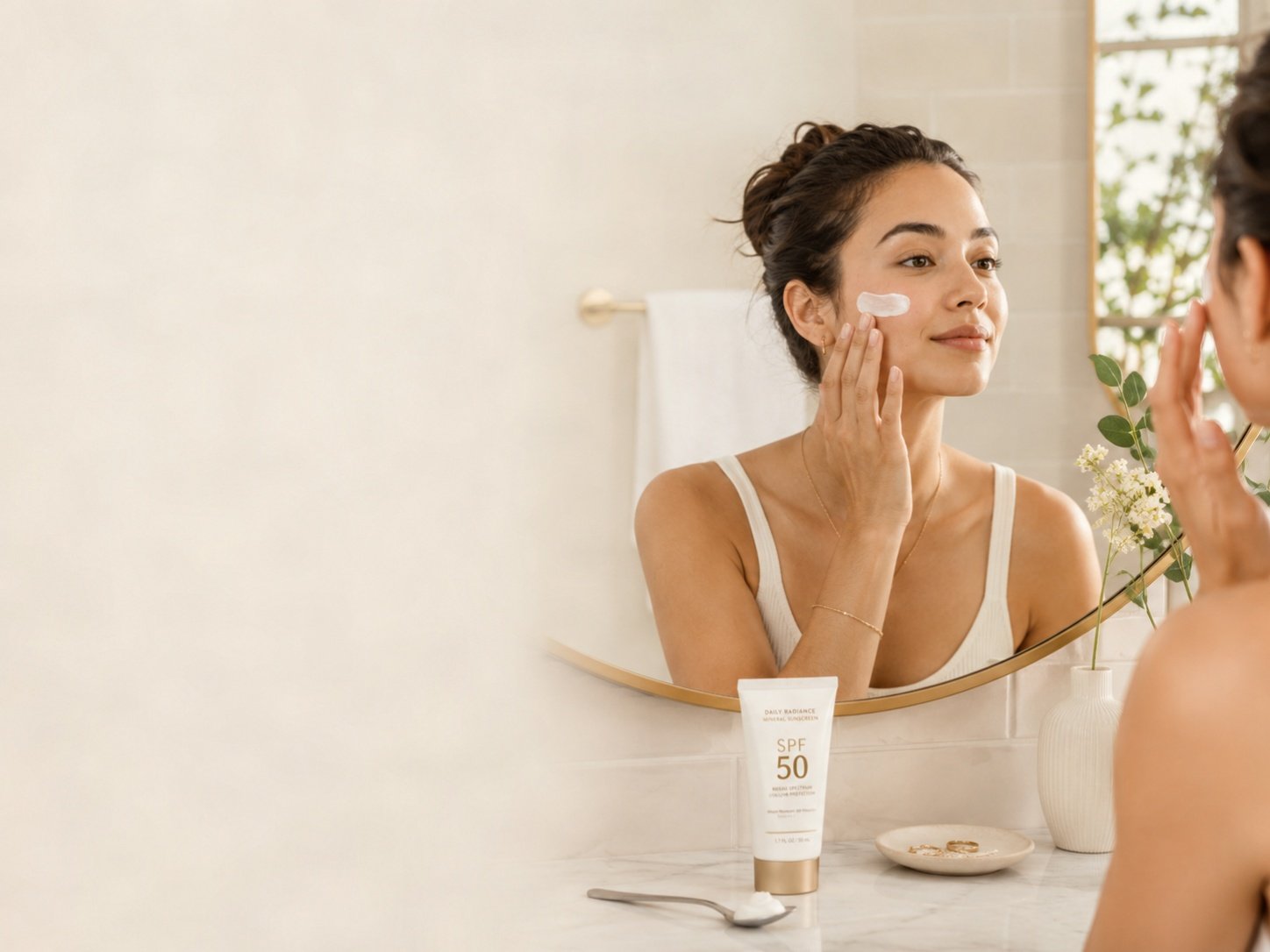
Sunscreen is one of those products most people own, but many people still use too little of it. A tiny dot on each cheek may feel like enough, especially if the formula is greasy, white, or hard to blend. But if you are asking how much sunscreen should you use on your face, the amount matters because sunscreen is tested at a specific application thickness.
When you under-apply, you may not get the level of protection shown on the label. I recommend thinking of sunscreen like coverage, not decoration. Your face, ears, hairline, lips, and neck all need attention. The goal is not to use a perfect-looking amount. The goal is to use enough product, blend it well, and reapply when needed.
How Much Sunscreen Should You Use on Your Face? The Simple Answer
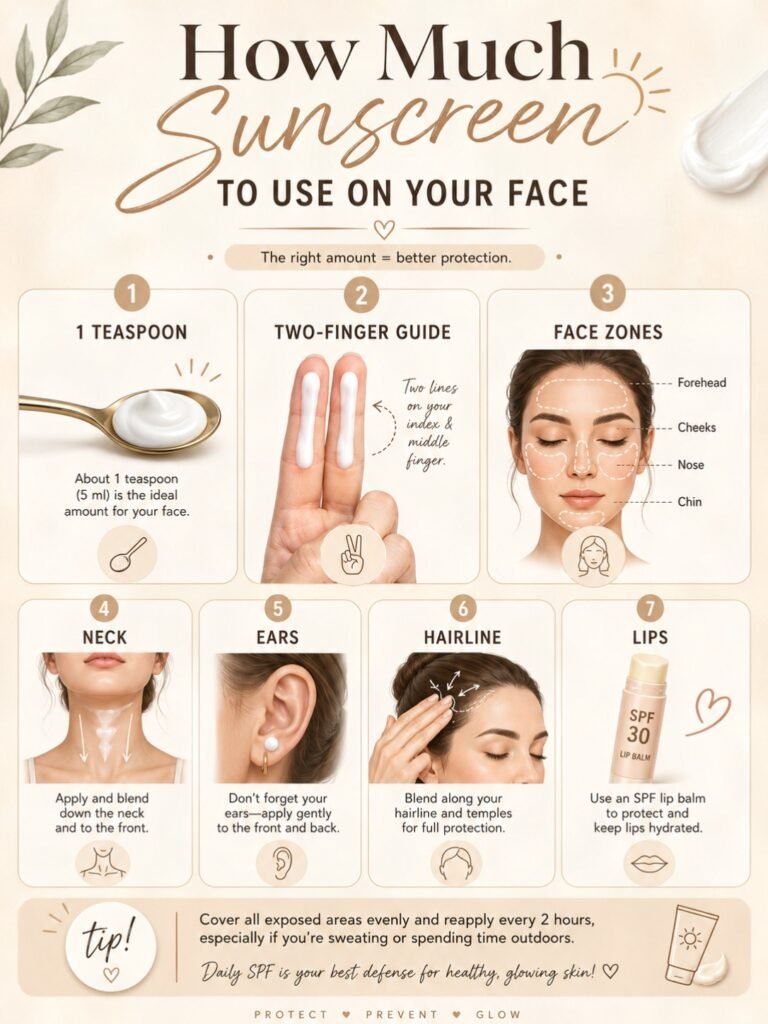
For your face, the American Academy of Dermatology sunscreen application guide recommends using at least 1 teaspoon of sunscreen, which AAD describes as about the amount needed to cover the length of your index and middle fingers.
That is the easiest answer to how much sunscreen should you use on your face:
- Use at least 1 teaspoon for your face
- Use enough to cover the full length of your index and middle fingers as a visual guide
- Apply extra for your neck, ears, hairline, and exposed scalp
- Use a lip balm with SPF 30 or higher for your lips
- Reapply when needed, especially outdoors
The same AAD guide recommends choosing a sunscreen that is broad-spectrum, water resistant, and SPF 30 or higher. It also says to apply sunscreen before going outdoors because it takes about 15 minutes for sunscreen to absorb and protect your skin.
This article is for general skincare education only. If sunscreen causes burning, swelling, rash, hives, severe irritation, or an allergic-looking reaction, I recommend speaking with a dermatologist or qualified healthcare professional.
Why the Right Amount of Sunscreen Matters
If you use too little sunscreen, you may not get the protection level listed on the bottle.
That matters because SPF is not just about the number on the label. It also depends on how much product you apply, how evenly you spread it, whether you miss areas, and whether you reapply.
The FDA sunscreen guide says to use enough sunscreen to cover your entire face and body, avoiding the eyes and mouth. FDA also says an average-sized adult or child needs at least 1 ounce, about a shot-glass amount, to evenly cover the body from head to toe.
For the face specifically, AAD gives the practical 1-teaspoon amount. That is why I do not recommend relying on a pea-sized amount of sunscreen for your whole face. It usually is not enough.
8 Practical Tips for Using Enough Sunscreen on Your Face
1. Use the 1-Teaspoon Rule for Your Face
The easiest rule is this: use at least 1 teaspoon of sunscreen for your face.
If measuring sunscreen every morning feels unrealistic, use the finger-length method. Apply sunscreen along the length of your index and middle fingers, then spread it evenly over your face.
This is one of the simplest ways to answer how much sunscreen should you use on your face without guessing every time.
What to try:
- Measure 1 teaspoon once so you know what it looks like
- Compare that amount to your usual application
- Use the index-and-middle-finger visual guide
- Apply in sections so it spreads more evenly
- Do not reduce the amount just because the formula feels heavy
If the recommended amount feels impossible to wear, I would switch formulas rather than under-apply.
2. Do Not Forget Your Neck, Ears, and Hairline
Your face is not the only area that needs sunscreen.
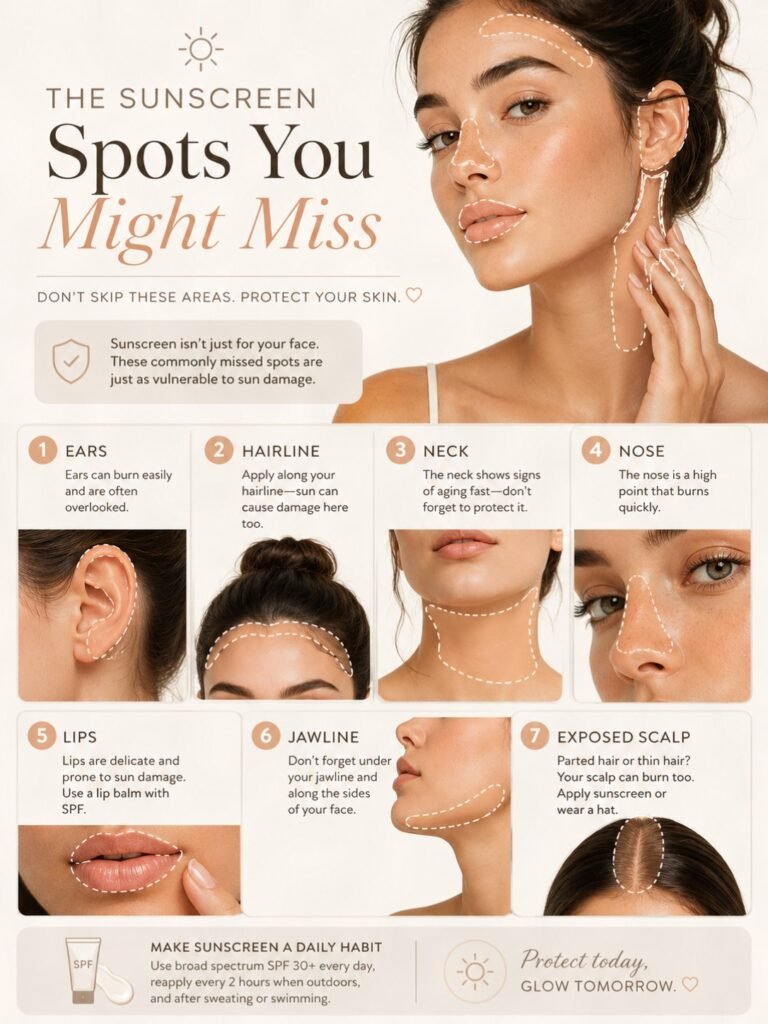
The FDA sunscreen guide lists frequently forgotten spots, including the ears, nose, lips, back of the neck, hands, tops of feet, hairline, and exposed scalp.
The AAD sunscreen FAQ also reminds people to apply sunscreen to areas such as the neck, ears, and top of the head.
What to cover:
- Forehead
- Cheeks
- Nose
- Chin
- Jawline
- Neck
- Ears
- Hairline
- Eyelids if your sunscreen is safe for that area
- Exposed scalp
- Lips with SPF lip balm
When people ask how much sunscreen should you use on your face, I always include the nearby areas. A perfectly protected face with exposed ears and neck is not a complete routine.
3. Apply Sunscreen Before You Go Outside
Timing matters.
The American Academy of Dermatology sunscreen application guide recommends applying sunscreen before going outdoors and says it takes approximately 15 minutes for skin to absorb sunscreen and protect you.
That means sunscreen should not be the product you apply after you are already in the sun.
What to try:
- Apply sunscreen as the last skincare step in the morning
- Apply it before getting dressed if your neck and chest are exposed
- Let it settle before makeup
- Keep sunscreen near your morning skincare
- Apply before driving, walking, gardening, or outdoor errands
I recommend building sunscreen into your routine before the day gets busy. Waiting until you are already outside makes it easier to rush or use too little.
4. Apply Sunscreen in Thin, Even Layers
If 1 teaspoon feels like a lot, do not smear the whole amount on at once.
I find it easier to apply sunscreen in two thinner layers. This can help reduce pilling, streaks, white cast, and greasy patches while still helping you reach the right amount.
How to apply it:
- Dot sunscreen on your forehead, cheeks, nose, chin, and jaw.
- Blend the first thin layer evenly.
- Wait briefly.
- Apply a second thin layer.
- Check the hairline, brows, ears, and jawline.
- Let it settle before makeup.
This method is especially helpful if you are trying to use the right amount but dislike the feel of heavy sunscreen.
5. Choose a Formula You Can Wear in the Right Amount
The best sunscreen is not always the one with the prettiest packaging. It is the one you can apply generously and consistently.
If a sunscreen burns your eyes, makes your skin greasy, leaves a strong white cast, pills under makeup, or feels too thick, you may start using less. That is the problem.
The AAD sunscreen FAQ explains that chemical, physical, and hybrid sunscreens can all effectively protect your skin if they are broad-spectrum, water resistant, and SPF 30 or higher.
What to look for:
- Lightweight gel or fluid if you dislike heavy creams
- Tinted sunscreen if white cast bothers you
- Mineral sunscreen if your skin is sensitive
- Oil-free sunscreen if you are very oily
- Moisturizing sunscreen if your skin is dry
- Water-resistant sunscreen if you sweat or swim
The right texture makes how much sunscreen should you use on your face much easier to follow.
6. Reapply Every Two Hours When Outdoors
Applying enough sunscreen in the morning is important, but it is not the whole job.
The AAD sunscreen application guide recommends reapplying sunscreen every two hours when outdoors and immediately after swimming or sweating. The FDA sunscreen guide also recommends reapplying at least every two hours, and more often if swimming or sweating.
Reapply when:
- You have been outdoors for about two hours
- You have been sweating
- You have been swimming
- You towel off your face
- You rub your face
- You are spending extended time near windows, outdoors, or in strong sun
The AAD sunscreen label guide explains that water-resistant sunscreens stay effective for either 40 or 80 minutes in water, depending on the label, and still need reapplication.
7. Do Not Rely Only on SPF Makeup
Makeup with SPF can be helpful, but I would not treat it as your only sunscreen step.
The reason is simple: most people do not apply foundation, tinted moisturizer, powder, or concealer in the same amount they would need to apply sunscreen. You may also skip areas like ears, neck, hairline, and jawline.
The AAD sunscreen FAQ notes that moisturizers and cosmetics with SPF are convenient, but sunscreen still needs to be reapplied approximately every two hours when outdoors.
What to do instead:
- Apply a dedicated sunscreen first
- Let it settle
- Apply makeup on top
- Use SPF makeup as extra support, not your only protection
- Reapply sunscreen when outdoors
SPF makeup can be a nice bonus. It should not replace your full sunscreen amount.
8. Use Other Sun Protection Too
Sunscreen is important, but it works best with other sun-protection habits.
The FDA sunscreen guide recommends limiting time in the sun, especially between 10 a.m. and 2 p.m., wearing protective clothing, sunglasses, and broad-brimmed hats, and using sunscreen regularly as directed.
The AAD sunscreen label guide also explains that no sunscreen filters out 100% of UVB rays, which is why shade and sun-protective clothing matter too.
Helpful extras:
- Wide-brimmed hat
- Sunglasses with UV protection
- Shade
- UPF clothing
- Avoiding peak sun when possible
- Lip balm with SPF 30 or higher
- Reapplying sunscreen on schedule
Sunscreen is powerful, but it does not have to do all the work alone.
How to Measure Sunscreen for Your Face
If you are a visual person, these methods can help.
The 1-Teaspoon Method
Measure 1 teaspoon of sunscreen once. Put it in your palm and notice how much it looks like. This helps you stop guessing.
The Two-Finger Length Method
Use enough sunscreen to cover the length of your index and middle fingers. AAD connects this visual guide to the 1-teaspoon amount for the face.
The Two-Layer Method
Apply half the amount first, then apply the rest as a second layer. This is helpful if your sunscreen feels heavy.
The Section Method
Apply sunscreen by section:
- Forehead
- Left cheek
- Right cheek
- Nose
- Chin
- Jawline
- Neck
- Ears
This helps prevent missed areas.
How Much Sunscreen Should You Use on Your Face If You Wear Makeup?
You should still use the full face amount before makeup.
A common mistake is applying less sunscreen because foundation, primer, or powder is going on top. But makeup does not fix under-application.
My makeup-friendly routine:
- Apply moisturizer if needed.
- Apply at least 1 teaspoon of sunscreen to the face.
- Add more for neck and ears.
- Let sunscreen settle.
- Apply foundation or concealer in thin layers.
- Use powder only where needed.
- Reapply sunscreen when outdoors.
If sunscreen always ruins your makeup, try a lighter texture, tinted formula, or sunscreen designed to sit well under makeup. Do not solve the problem by using a tiny amount.
How Much Sunscreen Should You Use on Your Face If You Have Oily Skin?
Oily skin still needs enough sunscreen.
The issue is usually the formula, not the amount. If the sunscreen feels greasy, you may be tempted to apply less, but that reduces protection.
What to try:
- Oil-free sunscreen
- Gel sunscreen
- Fluid sunscreen
- Matte sunscreen
- Lightweight hybrid sunscreen
- Blotting papers after sunscreen settles
- Powder only after sunscreen has set
If your skin is acne-prone, look for labels like non-comedogenic, oil-free, or won’t clog pores.
How Much Sunscreen Should You Use on Your Face If You Have Dry Skin?
Dry skin may need moisturizer before sunscreen so the SPF spreads evenly.
If your skin is flaky, sunscreen can catch on rough patches and make you want to use less. Better skin prep can help.
What to try:
- Use a gentle cleanser
- Apply moisturizer first
- Let moisturizer settle briefly
- Apply sunscreen in two thin layers
- Choose a moisturizing sunscreen
- Avoid harsh scrubs before SPF
Using the right amount is easier when your skin is comfortable underneath.
Common Sunscreen Amount Mistakes
Using a Pea-Sized Amount
A pea-sized amount is usually not enough for the entire face.
Skipping the Ears
Ears are easy to forget, but they are exposed to sun often.
Forgetting the Neck
If your neck is exposed, it needs sunscreen too.
Applying After You Are Already Outside
AAD recommends applying sunscreen before going outdoors because it needs time to absorb.
Relying Only on Foundation With SPF
Most people do not apply enough makeup to get full sunscreen-level coverage.
Not Reapplying
Morning sunscreen does not protect all day when you are outdoors.
Using Expired Sunscreen
The AAD sunscreen FAQ explains that FDA requires sunscreens to retain original strength for at least three years, and that sunscreen should be thrown out if the expiration date has passed or if the product has obvious changes in color or consistency.
FAQ
How much sunscreen should you use on your face?
You should use at least 1 teaspoon of sunscreen on your face. AAD says this is about the amount needed to cover the length of your index and middle fingers. Add more sunscreen for your neck, ears, hairline, exposed scalp, and any other skin not covered by clothing.
Is two fingers of sunscreen enough for the face?
The two-finger length method is a helpful visual guide. AAD says that when applying sunscreen to your face, use at least 1 teaspoon, about the amount needed to cover the length of your index and middle fingers.
Do I need sunscreen on my neck?
Yes. If your neck is exposed, apply sunscreen there too. Do not use your face amount and stretch it down too thin. Add more product for the neck.
How much sunscreen should I use under makeup?
Use the full recommended amount before makeup: at least 1 teaspoon for the face, plus more for the neck and ears. Let it settle before applying makeup.
Should I reapply sunscreen if I am indoors?
If you are mostly indoors and away from direct sun, reapplication needs may be different from a full outdoor day. But if you are near sunny windows, driving, sweating, or going outside, reapplication matters. When outdoors, AAD and FDA recommend reapplying about every two hours, and more often after swimming or sweating.
Can I mix sunscreen with moisturizer?
I do not recommend mixing sunscreen with moisturizer unless the product directions specifically say it is okay. Mixing can make it harder to apply sunscreen evenly. Apply moisturizer first, let it settle, then apply sunscreen.
Is SPF 50 better if I use less sunscreen?
Higher SPF does not give you permission to under-apply. AAD notes that many people apply only about 20% to 50% of the amount needed to achieve the SPF on the label. The better approach is to use enough sunscreen and reapply properly.
Conclusion
If you have been wondering how much sunscreen should you use on your face, the practical answer is at least 1 teaspoon for the face, about the length of your index and middle fingers. Add more for your neck, ears, hairline, exposed scalp, and lips.
I recommend choosing a sunscreen you can apply generously without hating the texture. Apply it before going outdoors, use enough to cover every exposed area, and reapply every two hours when outside, or sooner after swimming, sweating, or towel drying.
Once you understand how much sunscreen should you use on your face, sunscreen becomes less of a guessing game and more of a simple protective habit.
Sources
- American Academy of Dermatology how to apply sunscreen: https://www.aad.org/public/everyday-care/sun-protection/shade-clothing-sunscreen/how-to-apply-sunscreen
- American Academy of Dermatology sunscreen FAQ: https://www.aad.org/media/stats-sunscreen
- American Academy of Dermatology sunscreen label guide: https://www.aad.org/public/everyday-care/sun-protection/shade-clothing-sunscreen/understand-sunscreen-labels
- FDA sunscreen guide: https://www.fda.gov/drugs/understanding-over-counter-medicines/sunscreen-how-help-protect-your-skin-sun